CREST & R-SIRUS Researchers Publish Study on Water Stress and Demand Sensitivity Across the United States in Communications Sustainability
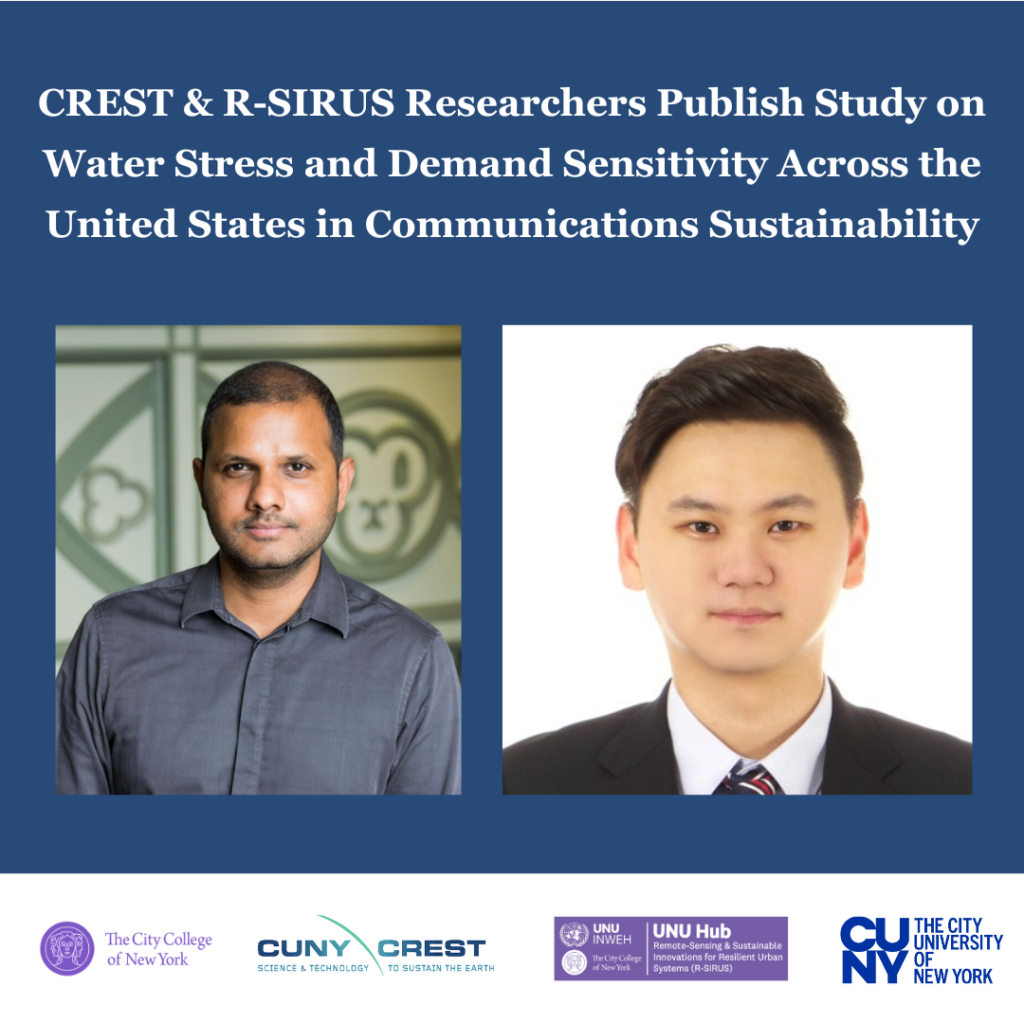
Drs. Naresh Devineni and Seon-Ho Kim co-authored the research paper Water Stress and Its Sensitivity to Demands Across the Contiguous United States, published in Communications Sustainability. The study examines how variations in water demand influence water stress across the United States, offering important insights into regional vulnerability and resource management.
Dr. Naresh Devineni is a faculty affiliate of the CUNY Remote Sensing Earth Systems Institute (CUNY CREST) and the United Nations University Hub for Remote Sensing and Sustainable Innovations for Resilient Urban Systems (UNU-Hub R-SIRUS) at The City College of New York (CCNY), where he also serves as Professor of Civil Engineering. Dr. Seon-Ho Kim is a Postdoctoral Fellow affiliated with CUNY CREST and UNU-Hub R-SIRUS at CCNY, working under the mentorship of Dr. Devineni.
The paper provides a comprehensive assessment of water stress by focusing on how variations in water demand across sectors such as agriculture, industry, and domestic use impact water availability in the contiguous United States. Moving beyond traditional supply-focused analyses, the research highlights the critical role of demand-side dynamics in shaping water stress outcomes.

Dr. Devineni said, “Our analysis provides scientific feedback for ongoing water conservation efforts and offers practical information in prioritizing regional water conservation strategies.”
The findings reveal that water stress is not only driven by hydrologic variability but is highly sensitive to human-driven demand patterns. This shows the importance of integrated water resource management strategies that account for both supply and demand, particularly under changing climate conditions and growing population pressures.
By identifying regions where water stress is most responsive to changes in demand, Drs. Devineni and Kim provide practical insights for policymakers, planners, and resource managers.
Dr. Kim said, “Water stress was most sensitive to changes in thermoelectric demand, while agricultural demand had broad geographic influence.”
This work advances the missions of CREST and R-SIRUS by promoting interdisciplinary, science-driven approaches to addressing environmental challenges and supporting more sustainable and resilient water resource management.