CUNY CREST and R-SIRUS Researchers Contribute to Global Dialogue on Clean Water at UN ECOSOC Youth Forum 2026
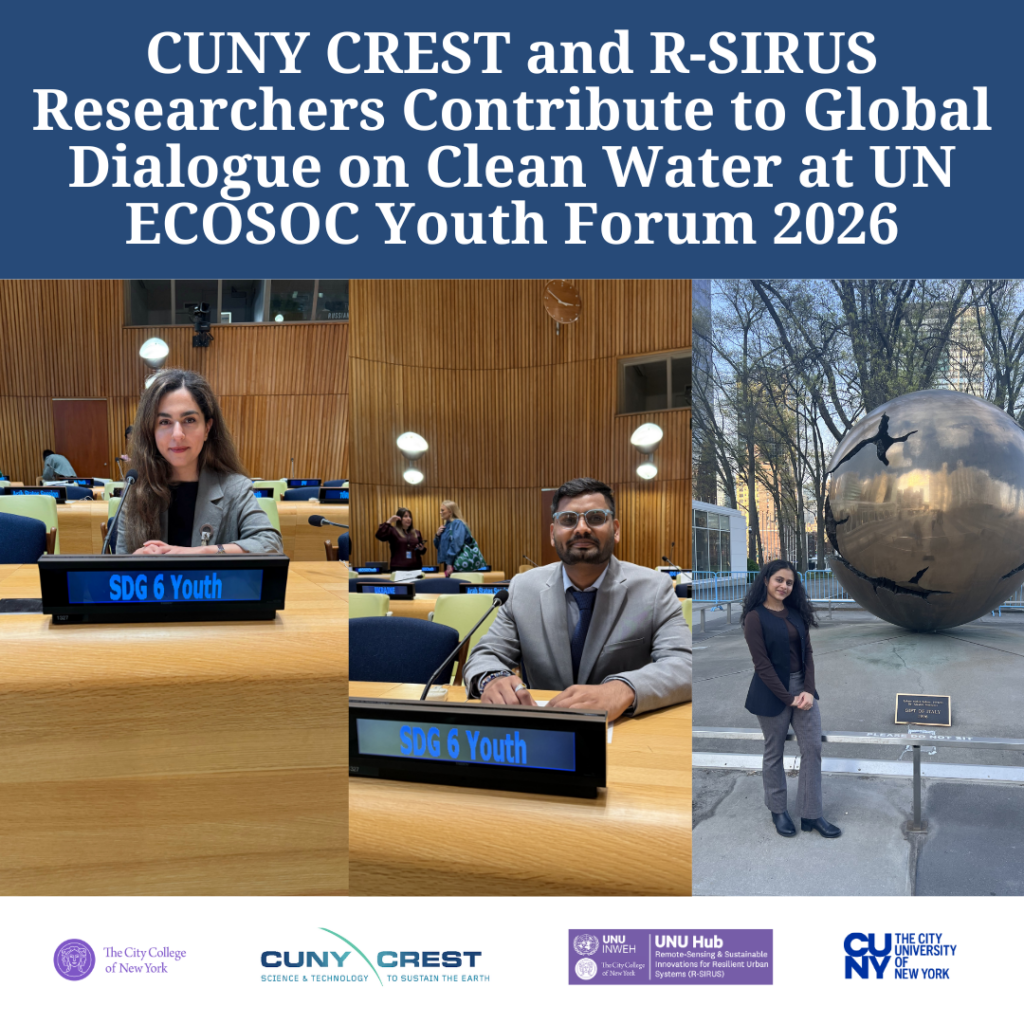
Dhrijesh M. Chauhan (Environmental & Water Resources Engineering) and Niloufar Soheili (Water Resources and Environmental Engineering), doctoral researchers at the City University of New York Remote Sensing Earth Systems Institute (CUNY CREST) Institute and United Nations University (UNU) Hub-Remote-Sensing and Sustainable Innovations for Resilient Urban Systems (R-SIRUS) at The City College of New York (CCNY) and Vasu Mittal (Sustainability in the Urban Environment), masters researcher at CCNY were invited to participate as respondents in high-level global discussions on water sustainability at The Economic and Social Council (ECOSOC) Youth Forum 2026, held at the United Nations Headquarters in New York on April 14, 2026.
During his intervention, Dhrijesh addressed the concern of microplastics in urban water systems. He emphasized that current monitoring frameworks lag behind evolving scientific understanding and called for the integration of microplastic tracking into SDG 6 indicators. He also highlighted the need to strengthen urban stormwater management systems and promote interdisciplinary collaboration across water engineering, waste management, climate science, and policymaking to tackle pollution at its source.
“Speaking at the United Nations for the first time was both an honor and a defining moment in my academic and professional journey. It strengthened my commitment to bridging research and policy, while also highlighting the responsibility of researchers to contribute to global discussions and drive solutions for pressing challenges like sustainable and safe water systems,” said Dhrijesh.
Niloufar’s contribution focused on the role of data in advancing clean water access and urban flood resilience. Drawing from her research on street-level flood warning systems in dense urban environments, she highlighted the importance of investing in city-scale observation infrastructure and open data frameworks. She also called for stronger institutional support to enable scientists to develop and scale innovative, real-time solutions for urban water challenges. “This experience was truly meaningful – a chance to bring my research on urban flooding into a global conversation. It reinforced my belief that young researchers have a critical role in shaping the solutions our world urgently needs.”
Vasu contributed to discussions on SDG 6 (Water and Sanitation), highlighting how water systems act as transmitters of solid waste mismanagement, particularly plastic pollution, amplifying environmental and public health risks. She also emphasized how conflict-driven policy failures are directly damaging critical water infrastructure, severely impacting WASH systems for vulnerable communities. “It was surreal realizing my own role as a driver of change, especially as member states shared their lived realities and efforts. It brought a new sense of urgency and responsibility. I am grateful for the opportunity to contribute.”
The participation at the forum reflects the mission of the CREST Institute and R-SIRUS to advance interdisciplinary research, strengthen global engagement, and drive impactful solutions aligned with the United Nations SDGs.
About CUNY CREST
The CUNY Remote Sensing Earth System Institute (CUNY CREST), based at the City College of New York, is a research institute within the City University of New York dedicated to advancing Earth system science, climate research, and remote sensing to address critical environmental and societal challenges. Learn more.
About the UNU-Hub R-SIRUS
The UNU Hub on Remote-Sensing and Sustainable Innovations for Resilient Urban Systems (R-SIRUS), located at the City College of New York, is committed to enhancing scientific understanding, developing innovative solutions, and preparing a skilled workforce to tackle global challenges related to water, the environment, climate, energy, health, and sustainable development. Learn more.