CREST Researchers Present Flood Resilience Studies at Caribbean Collaborative Action Network (CCAN)
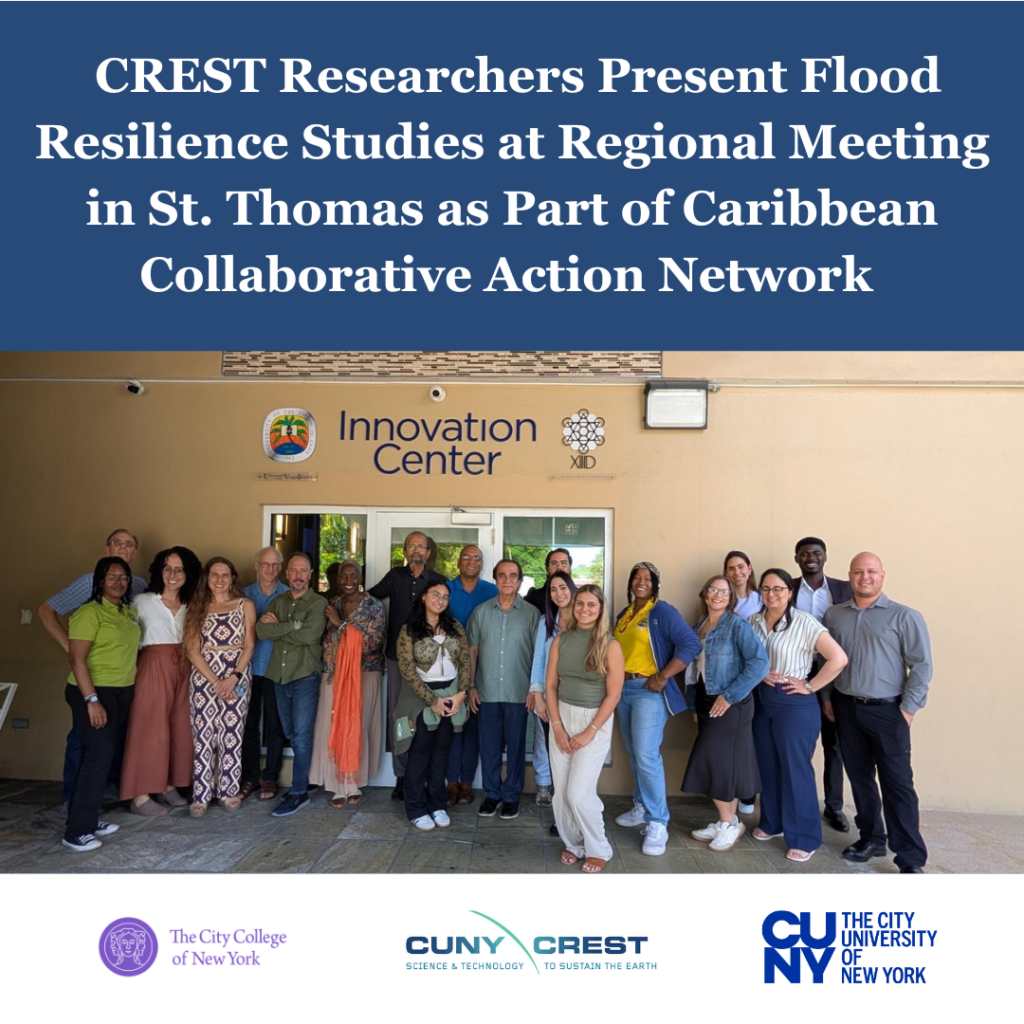
CUNY CREST researchers participated in a regional meeting held at the University of the Virgin Islands (UVI) campus in St. Thomas, where they presented innovative research focused on flood modeling, extreme weather impacts, and community-based resilience solutions for Puerto Rico and the U.S. Virgin Islands.
Professor Reza Khanbilvardi, Executive Director of the CREST Institute, and Ana Mejia Manrique, Doctoral candidate represented the institute. They delivered two technical presentations addressing critical challenges in flood risk assessment and climate adaptation.
The first presentation, Flood Extent Modeling Under Design Rainfall Scenarios from Radar-Based Depth-Duration Frequency Curves: Añasco Watershed, Puerto Rico, highlighted the use of high-resolution radar-based rainfall data to improve flood hazard mapping in inland watersheds. The study developed a watershed-scale hydrologic model for the Añasco watershed and generated flood inundation maps under selected design storm scenarios, addressing gaps in existing FEMA flood mapping coverage.
The second presentation, Understanding Hydrological Extreme Events Impacts and Co-Design Solutions with Communities in Puerto Rico and the U.S. Virgin Islands, showcased ongoing efforts to integrate Weather Research and Forecasting (WRF) reanalysis data and high-resolution precipitation radar observations to develop artificial intelligence models that improve precipitation forecasts. The project also includes flood simulations for multiple return periods and the spatial design of Community Nature-Based Solutions (CNBS) to support flood mitigation across Puerto Rico.

The event brought together researchers and stakeholders from several institutions, including the University of Puerto Rico campuses in San Juan and Mayagüez, the University of the Virgin Islands, the University of South Florida, Worcester Polytechnic Institute, NYU, and the University at Albany. Community leaders from St. Thomas also participated, sharing perspectives on local challenges and urgent resilience needs facing their communities.
The meeting provided an important platform for collaboration among academic institutions, government agencies, and community organizations working to advance climate resilience and sustainable flood management across the Caribbean region.