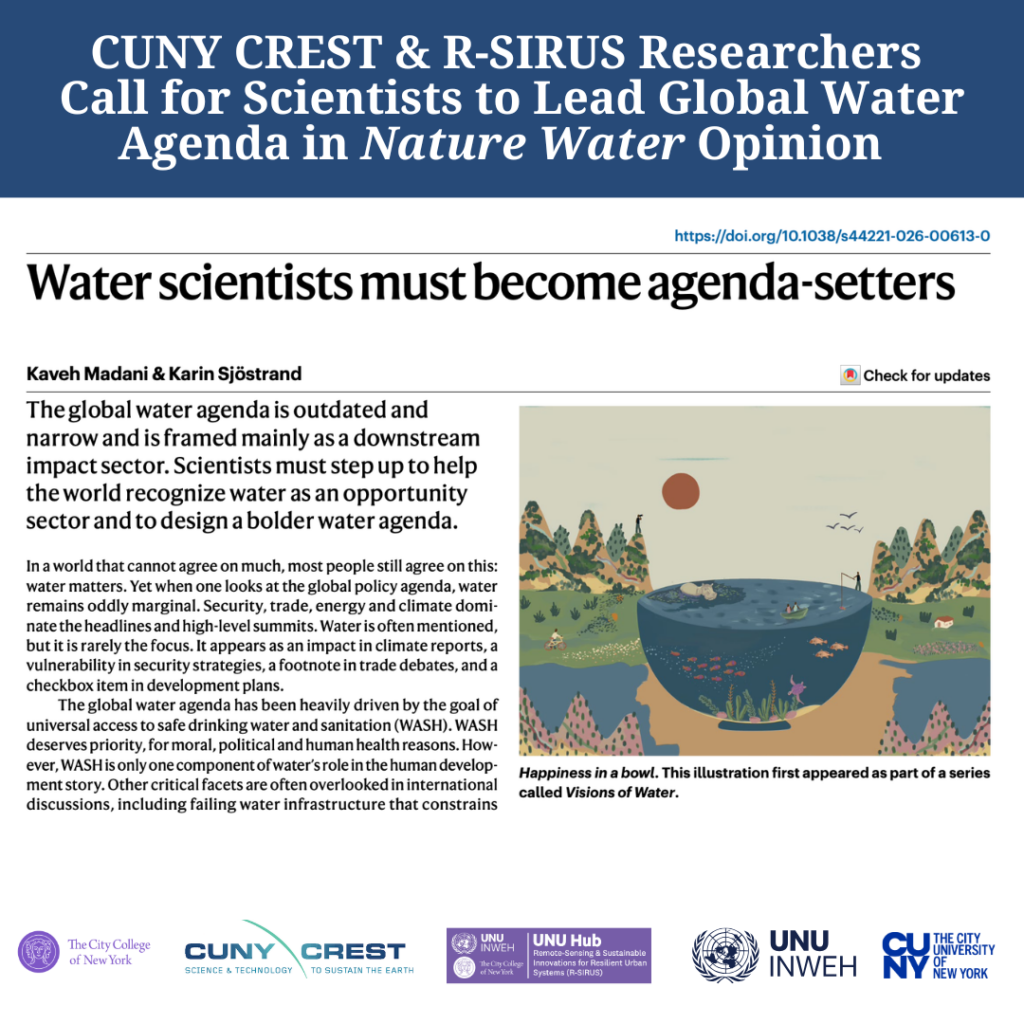
CREST & R-SIRUS Researchers Call for Scientists to Lead Global Water Agenda in Nature Water Opinion
In a new opinion article published in Nature Water, Dr. Kaveh Madani, Director of the United Nations University Institute for Water, Environment and Health (UNU-INWEH) and a CUNY CREST Institute affiliate and Dr. Karin Sjöstrand, Deputy Executive Director of Operations of the United Nations University Hub R-SIRUS at the City College of New York (CCNY), argue that water scientists must become agenda-setters in global policy discussions.
A Global Issue Still on the Policy Margins
Despite broad agreement that water is essential to human development and environmental sustainability, the authors argue that it remains surprisingly marginal in global policy debates. Issues such as energy, trade, climate, and security often dominate international discussions, while water is typically treated as a downstream concern.
Historically, global water policy has focused heavily on expanding access to drinking water and sanitation (WASH). While this remains critical, Drs. Madani and Sjöstrand emphasize that water’s role in development is far broader.
Key challenges that remain underrepresented include aging infrastructure, water-intensive agricultural and energy systems, transboundary water tensions, and the degradation of ecosystems that sustain the hydrological cycle.
Water as a Strategic Opportunity
Elevating water in global policy discussions could also unlock solutions across multiple environmental and development agendas.
Investments in protecting wetlands, forests, soils, glaciers, and aquifers, the natural systems that regulate the hydrological cycle, can simultaneously support climate mitigation, biodiversity conservation, disaster risk reduction, and sustainable livelihoods.
Because water challenges cut across political and ideological divides, the authors suggest water policy could also serve as a unifying platform in an increasingly polarized world.
Scientists as Agenda-Setters
Drs. Madani and Sjöstrand argue that water scientists must move beyond their traditional role of analyzing impacts and instead help shape international agendas. They highlight the upcoming 2026 United Nations Water Conference as an opportunity to reset the global narrative and place water at the center of discussions on sustainability and development.
Through initiatives like R-SIRUS at CCNY and UNU-INWEH, researchers are working to bridge science and policy, aiming for more sustainable water systems and societies.
Read the full opinion article in Nature Water and learn more about R-SIRUS, UNU-INWEH, and CCNY.